






Child-Centered Program
The Little Explorers Nature School is child-centered, meaning that our daily activities will be centered on the developmental needs and interests of the children, versus using a pre-set curriculum.
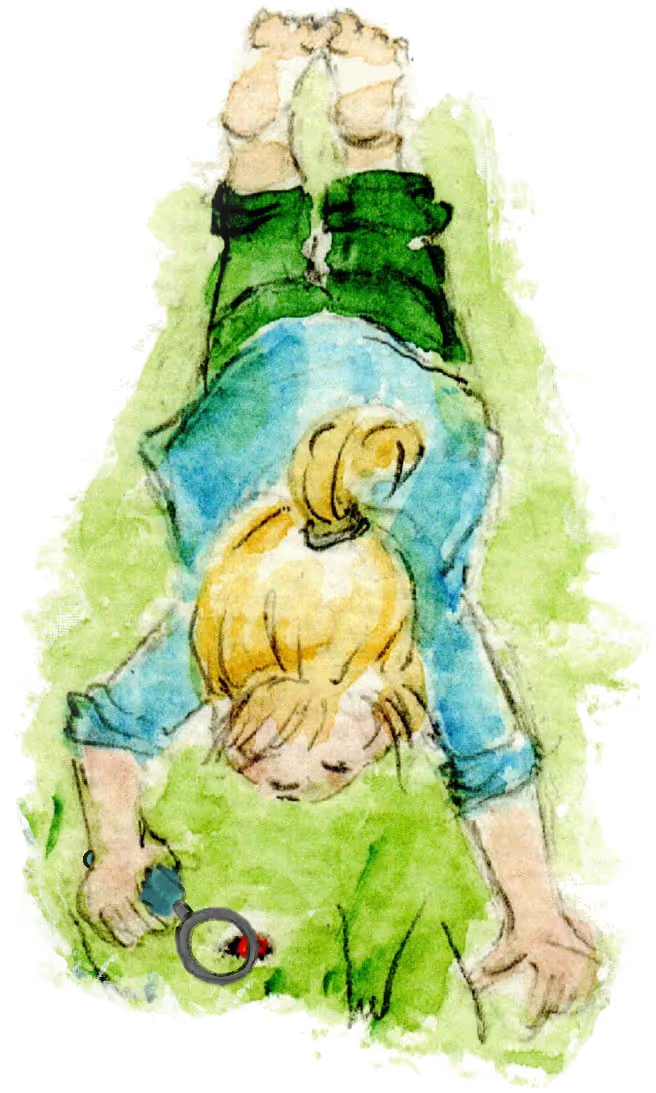
In their early years, children are extra curious and want to explore their environment with multiple senses which deepens their understanding in ways that they enjoy.
That’s why I offer a large variety of natural materials for them to explore, along with many special educational materials designed by Maria Montessori. The forest surrounding our property offers a wide array of great objects for exploration!
When their natural energy is channeled into joyful and purposeful activities, it inspires concentration, perseverance, responsibility, self-esteem, and self-control, giving them inner satisfaction and joy! A satisfied child with this kind of inner joy will be very sociable.
The children will explore, work, play, and learn together as a cooperative team in a variety of ways, while being encouraged to understand and demonstrate Christian values such as love, kindness, patience, joy, gentleness, compassion, integrity, and an understanding of being there for one another.
Program Areas:
Nature Science
–Mainly taught Outdoors
I am a strong advocate for being outdoors in the natural world. I grew up on a farm and helped my parents a lot, which I think caused an “I-always-want-to-be-outdoors-effect” for me 😊!
“. . . there is no description, no image in any book capable of replacing the sight of real trees, and the life to be found around them in a real forest” – Maria Montessori, "From Childhood to Adolescence"
Being outdoors brings joy, teaches many life skills, as well as fostering the immune system and overall health.
Showing children how to experience the natural world with all their senses has always been really important to me. A great quote from Maria Montessori puts this very well:
“The training and sharpening of the senses has the obvious advantage of enlarging the field of perception and of offering an ever more solid foundation for intellectual growth. The intellect builds up its store of practical ideas through contact with, and exploration of its environment. Without such concepts the intellect would lack precision and inspiration in its abstract operations.” – Maria Montessori, "The Discovery of the Child"
Staying connected with nature in this way is so important because it can help us stay grounded, especially in stressful times; helping children develop this appreciation early on will benefit them for their entire life.
Plants of Canada
Seeing the world through the lens of plants by exploring them and playing nature-experience-games in the forest: With trees, for example, the children can feel their bark while being blindfolded, do bark rubbings, make plaster casts of tree bark patterns, draw them, and do crafts with their leaves. All this helps them identify trees in a joyful way. The children will also learn interesting facts about native plants. The more they become familiar with the plants around them, the more mindful they will become as they walk through the forest. All this knowledge and experience results in a connection to native plants and naturally encourages children to want to take care of and respect them.
Weather of Alberta
Seeing the world through the lens of Alberta’s weather by simply being outdoors and observing and feeling the weather conditions: This helps the children understand the seasons, to choose proper clothing, and to be aware of dangerous weather conditions, which we can playfully learn how to respond to.
Animals of Canada
Seeing the world through the lens of animals by letting the animals come alive through action and fun: being in the same environment as the animals and exploring it, discovering where they sleep and what they eat, interpreting the traces they leave, watching them, moving like them in their environment, listening to their vocal communication, drawing and shaping them with playdough, reading and talking about them, and learning fun facts about their behaviour and habitats – all of this enhances the children’s interest and understanding of animals and encourages them to care for them.
Survival Skills
–Mainly taught Outdoors
Children naturally want to explore their surroundings which is a great entry point to learning basic survival skills. Learning how to navigate through unknown areas and to recognize natural resources fosters situational awareness, which is a great skill for learning to make good decisions. Learning how to be responsible for themselves and others, and how to be resourceful will help them become confident and calm in new situations. This kind of learning is meaningful and brings the feeling of adventure that children want to experience. Children who have been encouraged by purposeful, pleasant, and interesting activities in which they have been engaged are filled with health and joy and are remarkable for their calmness and discipline (inspired by Maria Montessori’s philosophy).
Navigation
Seeing the world through the lens of navigation develops an awareness of surroundings, special landmarks, spatial awareness, and memory skills that will be beneficial throughout their lives. The children will practice recalling routes they already went along. They will learn how to describe directions to guide others. We will use simple maps of our acreage that will help us navigate, and gradually increase the complexity of the maps. The children will be introduced to the compass and cardinal directions. We will integrate mapping skills into seasonal themes, such as telling stories about the theme that involves maps. Occasionally we will do “treasure hunts”, like finding “the fox in the box”, that motivate the children to read and follow the clues.
Basic First Aid
Seeing the world through the lens of basic first aid equips the children to build a base knowledge, skills, and confidence to help themselves and others in emergency situations, and to stay calm in stressful situations.
Also, the children will be more mindful of their surroundings and will understand potential risks, acting more carefully to keep themselves and others safe. This fosters the growth of safety awareness and decision-making skills.
Mathematics
–Mainly taught Indoors
Exploring math is enjoyable and concrete when connected to purposeful real-world examples, visual aids and hands-on materials which lead to grasping basic math skills.
This creates a lifelong solid foundation in math which helps the children to understand more complex math topics later.
Maria Montessori created many beautiful materials to help children understand numbers by observing what children like. These materials are designed to be appealing to children, which motivates them to use and engage with the materials.
Numbers
Seeing the world through the lens of numbers is fundamental for understanding and organizing our daily lives and for developing a basic knowledge of math.
Using sandpaper numerals, wooden card numbers, numbered spindle boxes, and bead bars involves visual and kinesthetic actions which creates more memorable learning experiences and a deeper understanding.
Measurments
Seeing the world through the lens of measurements by learning to measure various aspects of daily life such as length, time, temperature, volume, and weight helps children to understand the environment around them and to compare and quantify various attributes of objects and situations. For instance, using number rods (created by Montessori) to measure everyday objects provides a tangible representation of numbers for children, helps them understand length, and visualize and comprehend the relationships between different numbers.
Geometric Shapes and Solids
Seeing the world through the lens of geometric shapes and solids helps children name and recognize these solids in everyday objects, nature, architecture, and art. Children enjoy this knowledge, and the world becomes for them an interesting source of delight (inspired by Maria Montessori). For instance, using geometric wooden solids and shapes designed by Maria Montessori involves visual and kinesthetic actions creating more memorable learning experiences and deepening the children’s understanding of math concepts. If they look around in their daily life environment with this knowledge in their minds, they find excitement in recognizing and naming shapes at home and on walks. This recognition of shapes also provides a foundation that strengthens drawing skills.
Literacy
–Mainly Taught Indoors
Young children are very eager to read and write by themselves because it is a step for them to become independent!
Exploring letters while having fun engages the children with the wonderful world of reading and writing. As soon as they understand the relationship between the sounds of words and the letters in them and can blend letters into words, you can see their eyes sparkle! It is like an eureka moment for them :) Now they can decode words and start to write phonetic words (words that are spelled the way they sound, like “cat” and “dog”). This may seem like only a small step, but it is in fact a big step towards opening the door to academic and daily life – the ability to read is like breathing in information, stories, news, and so much more, and writing is like breathing out thoughts and ideas (inspired by Pamela Allyn).
Letters and Sounds
Seeing the world through the lens of letters, by learning to know the shapes, names and sounds of the letters, so children can recognize them, is essential for reading and writing.
The Montessori sandpaper letters and games like drawing a letter in sand or forming it out of playdough, are fun ways to memorize letters. Once children recognize the letter-sound correspondence, we can do phonological awareness games, for instance rhyming games, syllable clapping, “tongue ticklers”(Alliteration), “I spy” first sounds, or phoneme manipulation games.
Sign Language
Seeing the world through the lens of sign language enhances communication skills and supports literacy and cognitive development.
Using some American Sign Language supports memorizing the letters and is very helpful in understanding sound blending, which is the most crucial step for writing and reading!
If they memorize a few letters, their sounds and their signs, they will be ready to start recognizing familiar and short phonetic words. This prepares them to represent the sounds of spoken language through writing. These kinds of activities create a strong foundation for learning how to read.
Physical Development

How physically active we adults are, depends very much on the skills and movement confidence developed during our childhood. Learning basic movement and sport skills as a child is called Physical Literacy.
If we help children to develop these skills, like balancing, coordination, jumping, and so on, they will be more confident in their movements. This causes them to love moving along with the desire to remain active for life.
“As kids develop these skills and feel more confident using them, they are more likely to participate and be active. With physical activity providing so many physical (stronger muscles and bones), mental (improves mood and reduces anxiety) and social (promotes teamwork and helps build relationships) benefits, that is exactly what we want!” From “Six ways to help your child develop physical literacy (and why it matters) | WDG Public Health”
Another Great article about physical literacy is: Physical Literacy – Active For Life
I want the children to become physically literate and will give them opportunities to do so in developmentally appropriate ways.
Moving in the forest is a great way to develop and improve physical literacy. Simply walking through the forest improves balance, and our acreage provides many possibilities for running, jumping, going under and over things, and balancing. We will also do movements inspired by animals and plants: jumping like a frog, leaping like a hare, crawling like a bug, or doing swaying movements like plants in the wind.
Enrichment Activities:
Music with percussion instruments, singing games and dancing, words in different languages, like Spanish and German will be integrated as needed to enrich all program areas. Sometimes we will also learn about other cultures which helps children become open-minded, curious, and aware of the huge diversity of traditions, fashion, and food that other people can have.
Occasionally we will also explore animals and plants from around the world.
Final Note on Program Areas:
Children learn differently and at different paces, so this program is flexible to accommodate individual differences and is adaptable to your children’s needs. Therefore, it is not always possible to do everything as I have listed it in the program areas.
Come and See for Yourself!
If you would like to visit and see the space first-hand, or if you would like to meet in person to have your questions answered, don’t hesitate to reach out to me.
Contact


